








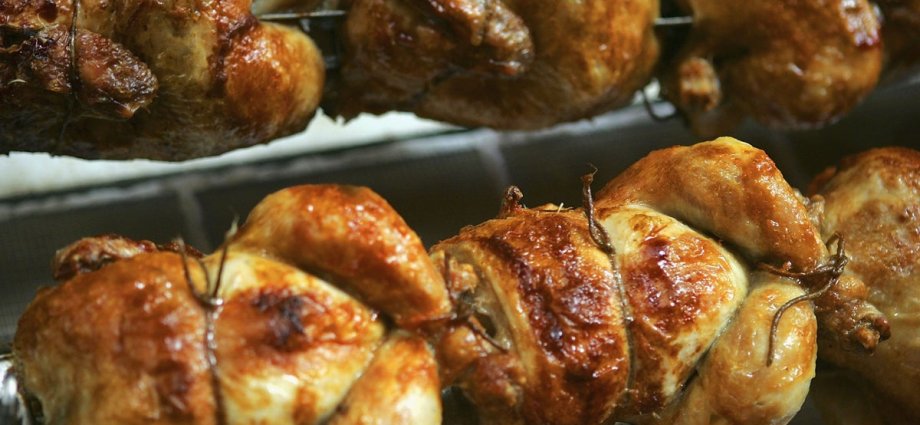
Morrisons is facing a substantial £17 million tax demand from HMRC, stemming from a dispute over the type of paper bags used for its popular rotisserie chickens.
The supermarket was issued a bill for £17,034,932 in 2021, with tax authorities asserting that the store-cooked birds are subject to 20 per cent VAT.
This ruling falls under controversial “Pasty Tax” regulations, introduced by David Cameron’s Conservative government in 2012.
The high street chain initially believed it had avoided the hot food levy, which sparked widespread public and industry outcry upon its introduction. Supermarkets and bakers, including Greggs, had warned that additional costs would be passed on to consumers.
The backlash prompted an amendment to the tax rules, stipulating that hot food cooked but then allowed to cool naturally would be exempt.
Morrisons contends that a 2013 tax inspection of its rotisserie operations concluded that its arrangements – chickens cooked and presented to customers in paper bags some distance from the cooking area – “appeared acceptable” to avoid the hot food tax.
But in 2021, HMRC said that because Morrisons’ chickens were sold in greaseproof paper bags with insulating or moisture resistant qualities, they were liable to be taxed at the standard rate, handing the supermarket the massive bill covering January 2017 to July 2020.
The chain appealed against HMRC’s ruling, arguing that for tax purposes its chickens were not actual hot food but merely “incidentally hot”. It claimed it had been given a “legitimate expectation” by the 2013 inspection that it was complying with the rules.
Lawyers argued that it would be unfair for the supermarket now to be ordered to pay huge backdated tax bills for its rotisserie birds.
But Judge Mark Baldwin, sitting in the Tax Tribunal, has now ruled against Morrisons, saying that HMRC was right to make the demand.
He said: “Morrisons, which operates a well-known supermarket chain, appeals against a number of assessments … as a result of HMRC’s decision that the sale of whole cool-down rotisserie chickens in the quarterly VAT periods January 2017 to July 2020 is liable to VAT at the standard rate. The total amount of VAT in issue is £17,034,932.
“Morrisons argues that HMRC gave clear and unambiguous rulings in 2012-2014 that cool-down rotisserie chickens were zero-rated. Morrisons says that it had a legitimate expectation that it could rely on those rulings, that it in fact relied on these rulings for over a decade and that it would be unfair and an abuse of power for HMRC to be able to resile from those rulings retrospectively and assess for past periods.
“Morrisons [says it] put all of its cards face up on the table by proactively inviting HMRC to meetings to discuss the correct VAT rating for cool-down rotisserie chickens and, explaining the background and concept behind cool-down rotisserie chickens, Morrisons then proceeded to invite HMRC officers to consider and clarify HMRC’s position … by visiting a local store, examining the products on sale and reviewing the signage.”
During the hearing, lawyers for Morrisons argued that it “could not have been more open” about its chickens and that an HMRC officer had observed cool-down rotisserie birds on display in-store on at least four occasions and had witnessed them being roasted, taken out of the rotisserie and bagged, labelled and displayed immediately.
Chickens had been prepared, displayed, packaged and marketed in the same way since HMRC had given approval for them to be zero-rated, the company claimed.
In those circumstances, HMRC’s attempts to charge VAT retrospectively were “manifestly unjust” after a decade of compliance with rulings and guidance and could be “crippling for a thin margin business”, the supermarket company argued.
But the judge said that the picture painted by the supermarket giant did not absolve it of the obligation to pay its tax bill.
He said that when the HMRC inspector looked at the chicken in 2013, “his understanding … is that they were ‘packaged in plain bags, left to cool naturally and made available for self-selection by customers from table type displays in the aisles'”.
However the officer had crucially “thought that the chicken paper bags were plain paper, and therefore non-heat retentive, bags”, which was not the case, he continued.
“We know that the chicken paper bags, although not designed to retain heat, are heat retentive and, much more importantly, are designed to prevent the leakage of hot fluids and grease,” he said.
“It is not [the HMRC officer’s] job to try to work out the properties of the chicken paper bags even if a non-expert could work out how heat retentive these bags were just by looking at them.
“As late as 2021, Morrisons were telling HMRC that the chicken paper bags were not heat retentive, when, as [Morrisons’ then finance Director Richard] Nichols readily acknowledged in cross-examination, this was just not true.
“The vast majority of hot takeaway food is standard rated. Selling hot chickens in packaging designed to retain fluids and grease is sufficient on its own for the chickens to be standard rated.
“Morrisons did not make full disclosure of all material information. In particular, Morrisons failed to disclose the heat and grease/fluid retention features of the chicken paper bags,” the judge concluded, upholding the taxman’s decision and confirming the £17m bill.
The judge added that, in addition to these proceedings, Morrisons has applied to the High Court for permission to apply for judicial review over the chicken tax row.