










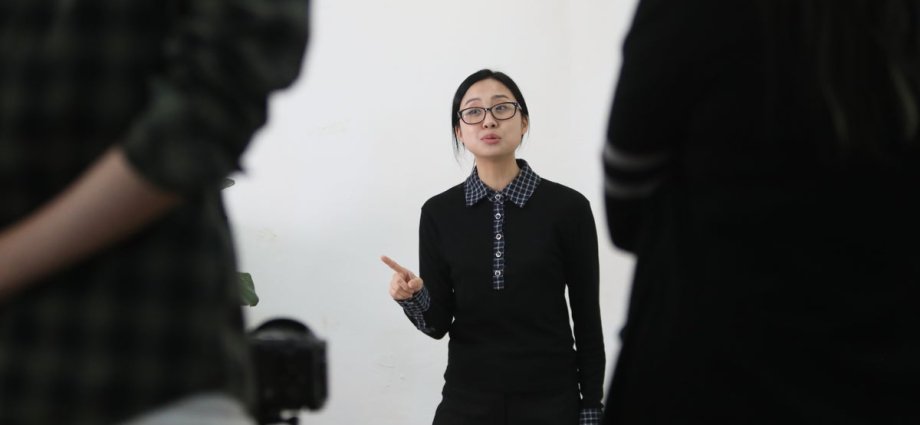
When actor Amy Baik secured a role in a South Korean commercial last year, she believed it was a promising opportunity. However, after filming concluded, she was dismayed to discover her scenes had been cut by both the director and advertiser, not due to her performance, but because she lacked a facial feature highly valued in South Korean beauty standards.
“The reason was that I don’t have double eyelids,” explained Baik, 26. This experience prompted her to question the aesthetic expectations within the Korean entertainment industry. “After receiving that feedback, I started to reconsider what kind of appearance Korea wants,” she said, adding it “made me wonder how I can survive as an actor in South Korea.”
This setback ultimately propelled Baik towards a different market. The global triumph of South Korean productions such as Parasite, Minari, and Squid Game has significantly broadened horizons for Korean performers in Hollywood. This surge in interest has, in turn, fostered a niche industry of consultants dedicated to guiding actors through the intricacies of American casting.
“Hollywood’s the dream (…) the ultimate pinnacle of acting accolades,” stated Julia Kim, a Korean American casting director whose credits include Minari, Amazon Prime’s Butterfly, and KPop Demon Hunters. While established figures like Park Hae-soo and Lee Byung-hun benefit from both South Korean and American representation, many aspiring Korean actors lack such crucial connections. This disparity is precisely what Los Angeles-based talent agencies, like Upstage Entertainment, aim to address.

Alison Dumbell, a co-founder of Upstage with extensive experience in both Bollywood and Los Angeles, has observed a growing demand from Western producers for “characters that are specifically Korean,” rather than generic “East Asian” roles. She attributes this shift partly to the burgeoning global popularity of South Korean entertainment. Nevertheless, persistent stereotypes remain a challenge. “The one that irritates me is the nerdy tech programmer,” Dumbell remarked. “Sometimes I just won’t even submit my actor for that because I know that they’re much more nuanced as actors.”
For the majority of South Korean actors without established networks or industry knowledge, Hollywood often feels like uncharted territory. Kim, who typically casts high-profile stars and collaborates with local casting directors for co-productions, also sources talent via social media. “I usually put out an open call on my Instagram,” she noted.
However, for actors lacking significant agency backing, identifying the right contacts proves difficult. The American and Korean industries operate distinctly, and US casting information seldom reaches those outside established professional circles. Kim highlighted the steep learning curve faced by South Korean talent. “I would get questions — should I change my Korean name to a Western name? Do I pay to get an agent? Can I look into the camera when I’m doing an audition?” she recounted. Even name consistency presents an issue; Kim recalled a K-pop artist turned actor whose name appeared in five different variations online.
Technical standards also diverge. Actor Misun Youm pointed out that American audition tapes necessitate clean white backgrounds, whereas “in Korea, it doesn’t matter.” Headshots, too, differ significantly: South Korean profiles often feature model-like images, while American headshots are tailored to specific character types. “In Korea, you shoot profile photos like a fashion magazine model,” explained veteran actor Shin Ju-hwan, known as Julian Shin, who played a masked soldier in the second and third seasons of Squid Game and stars in Taxi Driver Season 3.

Shin found Upstage by chance, after his wife, a producer, discovered them on LinkedIn. His Hollywood aspirations were partly fuelled by the success of colleagues at his former agency, such as Han Yeri in Minari and Jung Ho-yeon in Squid Game.

Watch Apple TV+ free for 7 day
New subscribers only. £9.99/mo. after free trial. Plan auto-renews until cancelled.
ADVERTISEMENT. If you sign up to this service we will earn commission. This revenue helps to fund journalism across The Independent.
Watch Apple TV+ free for 7 day
New subscribers only. £9.99/mo. after free trial. Plan auto-renews until cancelled.
ADVERTISEMENT. If you sign up to this service we will earn commission. This revenue helps to fund journalism across The Independent.
“Even though I wasn’t a main character — I was just a ‘soldier’ — people who saw even that brief appearance started leaving comments on my Instagram,” Shin said. “The impact of that show was truly unparalleled.”
Shin adopted an intensive approach to mastering English, transcribing over 30,000 English words and expressions from online sources, then utilising AI to verify if any phrases were outdated. “Idioms are really fun,” he commented. “‘Break a leg’ or ‘hold your horses’ — learning those makes you feel closer to being native.”
The question of accent remains a significant consideration. Devon Overman, another co-founder of Upstage who coaches English line delivery, affirmed that “it’s perfectly fine, even preferable to have an accent because the accent is part of who you are.”
She primarily focuses on intonation. “When native Korean speakers are trying to read English lines, it sounds like they’re reading. That’s the hardest thing to break,” she explained. Crucially, consultants are not encouraging actors to abandon their identity. Shin recalled Dumbell advising him not to sound overly “American-ish.” “She said people would prefer my genuine pronunciation,” he noted.
For Shin, the decision to pivot came as opportunities within South Korea began to contract. “Starting three years ago, I realised this industry was getting harder,” he said. “Since the Korean market was struggling, I thought I should broaden my horizons to international markets.”
Age discrimination is another factor driving some actors abroad. Youm, 29, observed that in South Korea, “30 isn’t considered young.” She added, “There are some limitations when it comes to finding an agency or auditioning for a role.” Shin, in his 40s, was given the chance to audition for a character in their 20s for an international production. “In Korean audition tapes, you usually say your age,” he highlighted. “In the U.S. (…) they don’t.”

Baik, who secured a minor role in the Netflix teen romantic comedy “XO, Kitty,” now perceives her distinctive features as assets in the international arena. Following feedback from American casting directors, she learned “I could do action roles and break free from the ‘cute’ image.” She also found working with an international crew to be an enlightening experience, appreciating aspects of American work. “In Korea, overtime was routine. In the American market, you clock in and clock out like an office worker,” she said. “It was more efficient.”
Her ongoing journey to Hollywood, she believes, has taught her self-reliance. “At first, everyone said it would be impossible (…) ‘Only famous Korean actors can do this,’” she recalled. “But after watching me fly overseas and make everything happen with my own hands…I can say with certainty from my experience that Hollywood is ready to open its doors to anyone.”
Shin, who harbours ambitions of playing a villain in American productions, also senses a profound shift. “There was a time when it seemed like you had to roll your R’s and act like an American… But now it feels like you can be yourself — be Korean if you’re Korean,” Shin concluded. “Stereotypes are gradually crumbling.”