










The human brain goes through five distinct stages of development during the average human lifetime, with measurable key turning points as we grow, mature, age and decline, new research suggests.
Neuroscientists at the University of Cambridge scanned the brains of almost 4,000 people aged 0 and 90 years old to identify the four milestones which mark fundamental changes in the neural connections which make our brains work.
One of the most surprising findings is that the period the scientists refer to as “adolescence” starts around the age of nine years old, but far from ending when you reach your twenties, carries on for over another decade until you are in your early 30s.
The researchm published in the journal Nature Communicationsm, found that our brains are constantly learning and adapting as we absorb new information. However, it is not a smooth journey of growth and consolidation, but one marked by flurries of activity – particular in the first half of life.
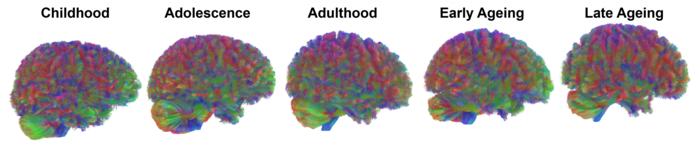
The five “major epochs” the team identified are:
Childhood – from birth to age nine
Adolescence – from nine to 32
Adulthood – from 32 to 66
Early ageing – from 66 to 83
Late ageing – from 83 onwards
These distinct eras were detected using datasets taken from MRI diffusion scans, which map neural connections in the brain by tracking how water molecules move through brain tissue.
“We know the brain’s wiring is crucial to our development, but we lack a big picture of how it changes across our lives and why,” said Dr Alexa Mousley, a Gates Cambridge scholar who led the research.
“These eras provide important context for what our brains might be best at, or more vulnerable to, at different stages of our lives. It could help us understand why some brains develop differently at key points in life, whether it be learning difficulties in childhood, or dementia in our later years.”
Childhood
During the first epoch, which is from birth through childhood until around nine years old, our brains are defined by “network consolidation”, the team’s research revealed. During this process, the wealth of synapses – the connectors between neurons – which are overproduced in a baby’s brain are whittled down, with only the more active ones surviving.
By the end of the first era, the brain undergoes a step-change in cognitive capacity, but this is accompanied by vulnerability as after this point the team said there is also an increased risk of mental health disorders.
Adolescence
During adolescence, the brain’s communications networks are increasingly refined, the brain scans showed.
This period is marked by the laying down of faster, smoother communication both within specific brain areas and across the whole brain – a transformation that powers a move to far stronger cognitive skills.
The team said this process is not usually complete until we reach our early thirties.
Adulthood
From the age of about 32, the longest epoch, that of adulthood, gets underway. Brain architecture stabilises compared to previous phases – with no major turning points for another thirty years.
This corresponds with a “plateau in intelligence and personality” based on other studies, the research team said.
They also found “segregation” is more noticeable during this epoch, as regions of the brain slowly start to become less strongly connected and more compartmentalised.
Early ageing
“The data suggest that a gradual reorganisation of brain networks culminates in the mid-sixties,” Dr Mousley said. “This is probably related to ageing, with further reduced connectivity as white matter starts to degenerate.
She said this is also a period “when people face increased risk for a variety of health conditions that can affect the brain, such as hypertension”.
Late ageing
The final brain structure epoch commences around 83 years old.
The team said the defining feature is “a shift from global to local”, as inter-regional brain connectivity declines even further. Meanwhile people tend to become increasingly reliant on certain well-trodden neural pathways and regions.
Duncan Astle, Professor of Neuroinformatics at Cambridge, said the team’s study will help understand the brain’s various vulnerabilities at different developmental stages, and how to minimise risks and treat particular conditions.
“Looking back, many of us feel our lives have been characterised by different phases. It turns out that brains also go through these eras,” he said.
“Many neurodevelopmental, mental health and neurological conditions are linked to the way the brain is wired. Indeed, differences in brain wiring predict difficulties with attention, language, memory, and a whole host of different behaviours.”
He added: “Understanding that the brain’s structural journey is not a question of steady progression, but rather one of a few major turning points, will help us identify when and how its wiring is vulnerable to disruption.”