










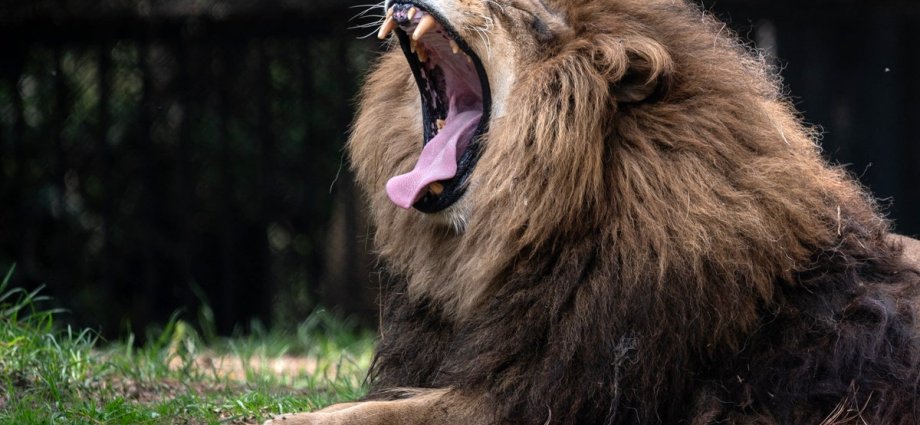
Scientists have discovered a whole new type of roar produced by African lions, indicating the big cat’s communication could be more complex than commonly believed.
Researchers from the University of Exeter said the finding could transform wildlife monitoring and conservation work.
Their study documented and classified an “intermediary roar” apart from the lion’s famous full-throated roar.
The researchers were able to differentiate between the two roars for the first time using artificial intelligence.
“Lion roars are not just iconic, they are unique signatures that can be used to estimate population sizes and monitor individual animals,” said Jonathan Growcot, a University of Exeter biologist who specialises in using modern technology for the conservation of large carnivores.
“Until now, identifying these roars relied heavily on expert judgment, introducing potential human bias,” Dr Growcot, an author of the study published in the journal Ecology and Evolution, added.
-gapes-as-it-sits-inside-its-enclosure-at-the-Chapultepec-Zoo-in-Mexic.jpeg)
The African lion is classified as vulnerable to extinction on the International Union for Conservation of Nature’s Red List.
Africa is estimated to have 20,000 to 25,000 wild lions, with their number decreasing by half in the last 25 years.
“Our new approach using AI promises more accurate and less subjective monitoring, which is crucial for conservationists working to protect dwindling lion populations,” Dr Growcot said.
The latest study establishes that a lion’s roaring bout contains a full-throated roar as well as a newly named “intermediary roar”, challenging the long-held belief that they produce a single sound.
The finding aligns with discoveries of multiple vocalisations in other large carnivores, like the spotted hyena, highlighting the growing potential of using AI for researching animal acoustics.
The new method of using AI to detect and classify lion sounds could make population estimation more accessible and reliable compared to traditional methods like camera traps or spoor surveys, the researchers said.
“We believe there needs to be a paradigm shift in wildlife monitoring and a large-scale change to using passive acoustic techniques,” Dr Growcott said.
“As bioacoustics improve, they’ll be vital for the effective conservation of lions and other threatened species.”