










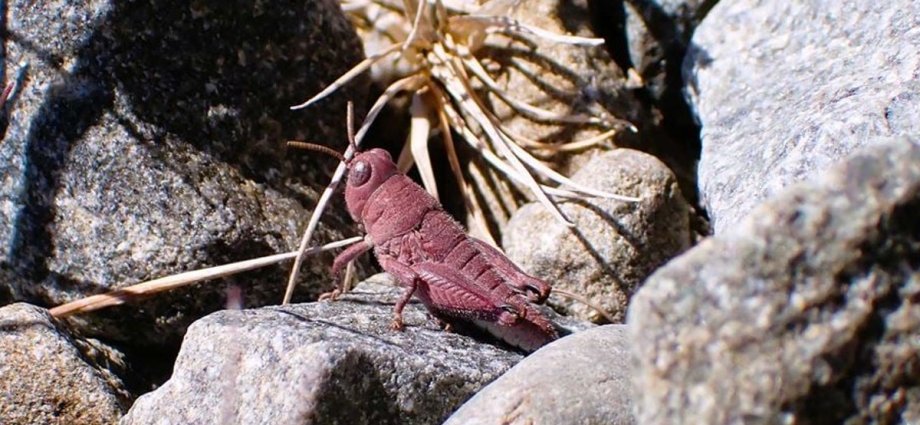
Researchers have spotted an “exceptionally rare” pink grasshopper near a lake in New Zealand, a discovery that sheds more light on colour-related mutations in insects.
The Sigaus robustus is one of New Zealand’s largest grasshoppers, found in shades of grey or brown.
It is usually found inhabiting the edges of some of the country’s rivers, such as the Mackenzie basin, which makes up a very specialised ecosystem of stones and boulders.
Zoologists have documented the endangered grasshopper widely, finding that it comes in many shades of grey and rusty brown, matching the stones and silty soils of its habitat.
But, during a recent survey, New Zealand department of conservation ranger Jen Schori stumbled onto an ultra-rare pink individual of the species.
“I’ve been studying these amazing creatures for years. They are usually grey or brown coloured like river stones. I’d heard rumours about a pink one but never seen one myself. It was so exciting,” Ms Schori said.
“Pink grasshoppers are exceptionally rare. It’s likely caused by a genetic mutation called erythrism which results in an overproduction of red pigment and less of the usual natural pigment that the species has,” she explained.

However, the rare pink colour which makes the individual stand out may also increase its risk of being spotted and attacked more easily by predators, the ranger says.
“The pink one will unfortunately stand out even more to predators which is why this sighting is so special,” she explained.
“These grasshoppers are so unique. They look almost prehistoric. They can jump fairly well but are renowned for their clumsy landings. They’re also very vulnerable,” Ms Schori said, adding that they face threats from predators like hedgehogs, cats and birds.
The endangered species gets some protection from fences put up by conservationists.
For instance, in 2018, rangers put up a predator exclusion fence around a small area of the grasshopper habitat in the Mackenzie basin.
It is thought to be the world’s first exclusion fence that has been built specifically for the protection of insects.
Unfortunately, the newly spotted deep pink female robust grasshopper was spotted in a different site outside of the fence, and may have to fend for herself.
“They do live up to their name, they’re quite robust and the females are double the size of the males. Maybe she will breed, and we will see some more pink ones,” Ms Schori said in a statement.
“I’m just so happy I got to see one after all these years. Getting out into nature in this part of the world is really special,” she said.