










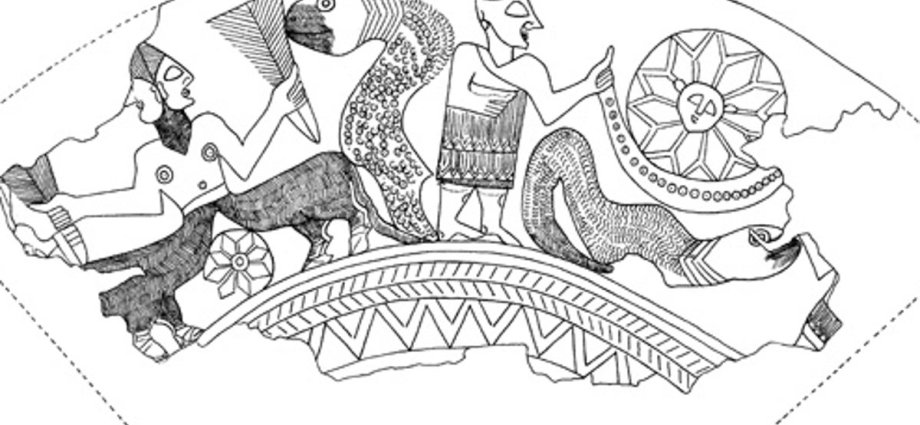
A 4,300-year-old silver goblet unearthed in occupied Palestine may bear the earliest known artistic depiction of the origin of the Universe, according to a new study.
The iconic Ain Samiya cup was found at an ancient grave site in the Judean Hill in 1970 and named after the Palestinian village in the Israeli-occupied West Bank near where it was found.
It was dated to the Intermediate Bronze Age of 2650–1950BC, when the region was populated by several nomadic communities.
The cup, three inches tall, bears artistic engravings of what appears to be a chimeric half-human, half-animal figure holding plants with a celestial emblem. There are also carvings of snakes and celestial symbols as well as a mysterious “boat of light”.
It was likely designed in southern Mesopotamia around 4,300 years ago, using silver sourced from either Syria or silver-abundant modern-day Iraq.

Previous interpretations said the contrasting imagery on the goblet depicted a world of chaos with plants, animals and humans, ruled over by a serpent.
Some archaeologists also believed the engravings represented a Babylonian creation myth called the Enuma Elish which tells the story of a god named Marduk defeating a supernatural agent of chaos called Tiamat.
The new study, published in the Journal of the Ancient Near Eastern Society, suspects the goblet’s myth predates even the Enuma Elish.
Researchers say the design is the earliest depiction of the origin of the cosmos, showing the universe shifting from a pre-creation chaos to newly forged order.
The new interpretation of the art states that it depicts a time “when heaven and earth, animals, and plants were fused together so that they could not develop their potential”.
Researchers theorise it combines elements of different myths and legends from across ancient Mesopotamia.
By way of an example, they say one of the motifs shows human beings holding up Sun mirrors, similar to the Celestial Boat design that appears on 11,500-year-old pottery from Turkiye’s Göbekli Tepe.
“The Ain Samiya goblet does not depict scenes from the Enuma Elish as the goblet predates the Babylonian creation myth by more than a millennium and it’s notably devoid of violent imagery,” the study notes.
Contrary to a previous interpretation that it may represent a mythological battle, the study argues the art depicts a moment of peace, showing the sun rising and dispelling chaos to renew the world.
“The scenes depict a transition from chaos to a structured universe, protected from chaotic disturbances by deities,” the study states.
“There’s particular focus on the birth of the sun deity and its subsequent journey through the cosmos, which in the context of the tomb may serve to facilitate the rebirth of the soul of the dead.”