










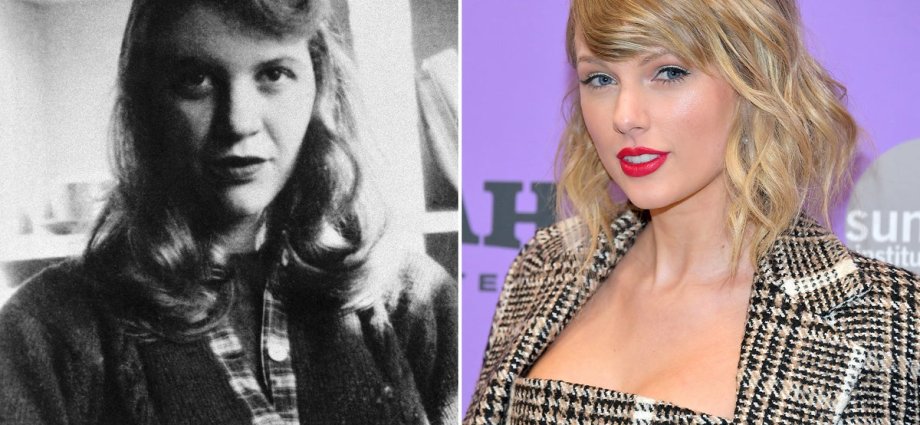
Taylor Swift will no doubt love being compared to Sylvia Plath. Especially when the comparison comes from Maggie Nelson, one of the greatest living non-fiction writers and author of the it-girl philosophical memoir, The Argonauts. Because, of course, Swift is a self-professed tortured poet: a woman who stacks literary references like chord progressions, no bard too sacred, no play or fictional character too obvious to include in a song. This is the woman who put on an auburn wig and signed a copy of her imaginary debut novel All Too Well in the video of the same name.
Despite how she aligns with the literary, there’s little that meaningfully connects Swift to Plath – least of all in their work – beyond the fact that both are (or were, in Plath’s case) industrious female artists who wanted to be famous and then became icons. Which is reason enough, I guess, for Nelson’s new essay-length book, The Slicks: On Sylvia Plath and Taylor Swift, to make a mostly weak case that they are cultural sisters.
The book’s title comes from a line in Plath’s diary: “I will slave and slave until I break into those slicks.” The “slicks” being glossy, high-end magazines – the kind Plath longed to conquer, a goal she’d surpass before her death at age 30. Promo text for Nelson’s book describes it as exploring “twin hosts of the female urge towards wanting hard, working hard, and pouring forth – and as twinned targets of patriarchy’s ancient urge to disparage, trivialise and demonise such prolific, intimate output”. After reading it, I’m less convinced than I was before. They’re neither twins nor sisters, perhaps very distant relatives.
With The Slicks, Nelson is doing what’s become a cliché of contemporary criticism: flattening the divide between high and low, treating poetry (inaccessible, cerebral) and pop (sparkly, unserious) with equal gravity. It’s a balance that makes literary criticism more readable, grounded in the real world, and, frankly, more lively – all qualities of Nelson’s work. Whether you enjoy Swift’s music or not, the comparison is flattering to her. Just when I started to think of dear Maggie in a room forced to write this against her will – blink twice if you need help – Nelson reveals herself to be a card-carrying Swiftie, calling the artist a “genius”.
The essay works best when you read it as a love letter to Swift or when Nelson is simply offering elegant observations about either woman in isolation. It reminds me faintly of Alana Massey’s All The Lives I Want: Essays About My Best Friends Who Happen to Be Famous Strangers, a book I enjoyed on its release in 2017, which takes “difficult” women like Plath, Britney Spears and Anna Nicole Smith and assesses them via writing that is part cultural criticism, part fan letter. Relatedly, The Slicks makes for an interesting companion piece to Tavi Gevinson’s satirical genre-blending zine Fan Fiction, about Gevinson’s experience going from being a Swift fan to being Swift’s actual friend. After all, Swift has a brilliant ability to pull women in and make them feel intimately acquainted with them.
But The Slicks becomes less effective than either of the above when Nelson attempts to make links between the two artists, in the process writing lines that are factually true but nevertheless could have existed on Tumblr circa 2012: “When I think about Swift and Plath together, I find myself returning to a simple thought: Sylvia Plath is dead, and Taylor Swift is alive.”
By its premise alone, The Slicks feels quite dated – a relic of that convergence of mid-2010s poptimism and girlboss feminism, whereby every act by a woman was radical and most criticism of pop stars was held up to the light for residue of sexism. A useful time for the progression of humanity but a specific period we have evolved beyond. It’s strange to see Nelson willingly step into that trap, to buy into the idea that because some criticism of Swift has had genuinely sexist undertones, all criticism of her does.
When Nelson writes, “Last time I checked, Swift was not angling to be a great poet,” it doesn’t ring true. If there is one thing I believe about Swift it is that her raison d’être is to be as famous as humanly possible for being a great writer, which is why it can feel palpably cringey when her work doesn’t live up to that. (“The Fate of Ophelia”, for example, and whatever is happening in the “Fortnight” video).
Nelson’s own defence of Swift as a serious literary artist – for instance, when she notes that “all but a handful of the 44 songs on Swift’s Eras set list are in the lyric tradition of love poetry” – only reinforces that ambition. And when Nelson goes on to add, “Some people grouse that Swift’s artistry is tainted by its being the engine of a billion-dollar industry… welcome to the world of pop music; it ain’t poetry,” the dismissal lands glibly. It’s difficult, and perhaps fruitless, to ignore the causal relationship between Swift’s art and her capitalistic drive – her last few albums have been increasingly weak, as if the density of money itself were rotting the work from within.
There is a convenient academic flattening of Swift (person, phenomenon, work) as one feminist text that doesn’t lend itself to interrogating the biggest artist on the planet at a bizarre cultural turning point for women, music, creativity, money, technology, and most things.
The familiar sexist script that once surrounded Plath, Nelson argues, “was on full display” in the wake of The Tortured Poets Department: “Rote shaming of making the personal public; calls for the artist to look outside herself for subject matter; charges of her vulnerability being faux, or deployed as manipulative marketing tool; tongue-clucks about self-indulgence and being ‘in need of an editor’.” But this all feels overstated. The bulk of serious criticism about TTPD boils down to something far less ideological: it’s a surprisingly drab album from a good artist. People wanted a raw, confessional, self-indulgent record about her doomed fling with Matty Healy, but TTPD wasn’t quite it. Rather than intimate, the music and the lyricism felt uncanny, almost AI-like. Nelson even calls the record “relatively complicated and dark”, an odd comment in an essay about Sylvia Plath’s suicidal poetry. Did we hear the same album?
In a Guardian interview to promote The Slicks, Nelson claimed that silencing women like Swift is part of a patriarchal project: “There’s something about wanting, and naming your want – which I think both Plath and Swift did – that is still generally a punishing sphere for a woman.” I don’t think that’s true, and I don’t think it’s been true for a long time. We live in a obsessed with wanting – desiring, manifesting, announcing – loudly. The punishment for women now isn’t in wanting too much, but too little. To not strive higher is to present incriminating proof of one’s failure to self-actualise. Maybe Nelson’s idea was true in Plath’s time, perhaps still correct for Nelson’s Gen X cohort, but certainly not for Swift or the majority of readers of this essay.
There is little grappling with the discourse surrounding Swift here. People aren’t put off by her ambition – or by the unapologetic drive of any top-performing artist who dominates the pop industry, from Beyoncé to Sabrina Carpenter, the majority of them women – but by what reads to some as greed. In a world this brazenly corrupt, the plutocrat has become a suspect character. As the saying goes, there’s no such thing as an ethical billionaire. Or, as Billie Eilish recently put it at a Forbes event attended by Mark Zuckerberg and George Lucas: “If you’re a billionaire, why are you a billionaire? No hate, but give your money away, shorties.”
It can be said that Swift has perfected the art of “variant”, gamifying vinyl collecting and flooding the market with endless editions to inflate sales, with music fans and industry experts now suspecting she releases new versions to block rivals like Charli XCX from hitting No 1. When Nelson writes that resentment of powerful women is “most obvious in Maga/incel circles”, she also sidesteps Swift’s associations with conservative entities like Brittany Mahomes or Barstool Sports, and the quiet conservatism people are correctly or unfairly projecting onto her current image. How much of this is really about female ambition and how much about the ungendered monopolising logic of the market?
As a Swift fan, Nelson probably couldn’t have predicted the cooler reception that followed this year’s The Life of a Showgirl – the weakest release of Swift’s career, too thin even for her devotees to defend. The New York Times dubbed its conservatism “an appropriate text for the Trump era”, and elsewhere likened the Swift machine to the Marvel franchise: bloated, cynical and tacky. Music overtaken by marketing, is the current party line. It’s for this reason that The Slicks feels as though it suffers from not having been released a year ago, before the tide turned.
By the emotional climax and sign-off of Nelson’s conclusion, she’s completely lost me. When Swift performed “Midnight Rain” – her self-mythologising hymn to ambition – on the Eras tour, Nelson describes the moment as joyous, even redemptive. It reminded her, she writes, of an image evoked earlier in the essay: Plath, as recalled by her friend Al Alvarez shortly before her suicide, “pale and drained, hair unwashed and loose”. In Swift’s lyric, “All of me changed like midnight rain,” Nelson hears “her and Plath’s conjoined commitment to transformation, to going wherever their pour might take them”. It’s an arresting juxtaposition, but the comparison only underlines the problems with Nelson’s reach, too far across time, tone, and tragedy.
One idea from The Slicks has stuck with me though: that there might be self-deification inherent to both artists’ ambitions. “I think I would like to call myself, ‘The girl who wanted to be God,’” Plath wrote in her Journals. Though Nelson doesn’t go on to provide evidence of Swift feeling that way, it’s fun to imagine that someone like her, who has become a global superpower, does crave that omnipotence. To imagine that appearing in the slicks was nothing to Swift but a micro-step on her way to becoming bigger than God.
The Slicks: On Sylvia Plath and Taylor Swift is out now, published by Penguin